Artificial Intelligence for Translators and Interpreters

I recently took a 10-hour Zoom course on “Artificial Intelligence for Translators and Interpreters,” taught by Nora Díaz (a born teacher) and offered by Fernando Cuñado and Ruth Gámez on their Academia de los Grandes Traductores platform. For me it was a perfect introduction to how AI can have a positive impact on T&I work.

Nora logically commenced with an overview of AI and large language models, initially highlighting the AI capabilities integrated into Microsoft Suite and Google Suite. She then demonstrated how ChatGPT, Gemini, and Copilot can work as “interns” to assist translators and interpreters in automating multiple tasks (including terminology extraction and glossary building), and how to draft effective prompts to get the desired results. Nora demonstrated that much of this can be even further automated with PhraseExpress.

The session on AI and CAT tools focused on Wordscope (the first CAT tool with ChatGPT integration), as well as how to set up and use the Trados Studio AI Professional plug-in. Apps specifically for interpreters were also reviewed, featuring real-time transcription, including Cymo Booth and Cymo Note. Each day practice exercises were provided to do together in class, although the sessions were recorded and are available for future viewing. The course was in English but Nora and Fernando have promised future editions in both Spanish and English, too.

ES-EN Legal Translation Blog in 2023

WordPress tells me that 42,531 people viewed my blog content during 2023. I
am quite aware that’s hardly a drop in the bucket for many sites. But it may
actually be a lot for this ES-EN legal translation niche, and encourages me to
continue to add new entries in 2024. I say this because, not long ago, a
lawyer-linguist colleague suggested that my type of language-specific content
is no longer of much interest to translators and interpreters. He suggested
that the focus has now turned to other more technical topics, such as how to run a translation business, translator and interpreter training, the use of plain
or inclusive language, or the impact of AI on T&I, among others.

But I still have lots of ideas concerning the linguistic aspects of legal
translation that I want to add to my 300 already-published blog entries in the
upcoming months. They will still be organized in the same categories that I
invented when commencing the blog in 2016:

  • False Friends (yes, I admit I’ve been
    called la loca de los falsos amigos)
  • Multiple Meanings (Polysemy)
  • Confusing Terms
  • Frequent Mistranslations
  • Español Jurídico
  • Common Terms with Uncommon Legal Meanings
  • Expressing Spanish Civil Law Concepts in Common Law Terms
  • Latinismos
  • Ellipses in Legal Spanish
  • Capsule Vocabularies
  • Terminology Sources,
  • Legal Language in the US and UK

 ¿Nos vemos en 2024?

Un abrazo desde Madrid

False Friends: “asesinato” vs. assassination

These are true false friends, “assassination” (the deliberate killing of a public figure) being magnicidio, while asesinato is generally associated with “murder” (the intentional premeditated unlawful killing of a human being). With respect to the latter, the specific related offenses defined in the Spanish Criminal Code (Código Penal) include homicidio imprudente, homicidio (doloso) and asesinato. How these terms are translated may depend on the target audience, but generally homicidio (doloso), defined as matar dolosamente a otra persona, may perhaps be best rendered simply as “murder.”

In contrast, as defined in Spain asesinato requires killing con alevosía (measures that an offender takes to ensure their impunity), por precio, recompensa o promesa (for hire, reward or promise of reward), or con ensañamiento (with extreme cruelty). Committing murder con alevosía implies depriving the victim of any means of defense (inexistencia de posibilidades de defensa por parte del sujeto pasivo), while ensañamiento is defined as aumentar deliberada e inhumanamente el sufrimiento de la víctima en la ejecución del delito. In view of these requisites, if homicidio (doloso) is rendered as “murder,” asesinato may perhaps be appropriately described as “aggravated murder” or “first-degree murder.” In other respects, homicidio imprudente may possibly be rendered as “manslaughter” (unlawful killing without express or implied intent to do injury), but when a distinction must be made between homicidio imprudente grave and homicidio imprudente leve expressions such as “reckless homicide” and “negligent homicide” may perhaps prove useful.

Spanish-English Legal Terminology in the New Year

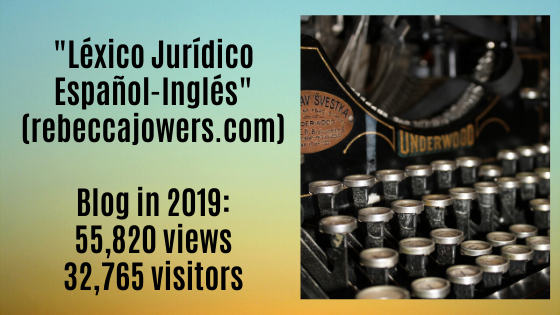
Blog stats 2019

When I started this blog in 2016, I wondered whether there would be much interest in articles devoted exclusively to the translation of Spanish and English legal terms. Although I enjoy input concerning translation theory, methods, and tips in general, I felt there might be a niche for a more specifically specialized blog focused on the nitty-gritty of rendering some of the more difficult concepts of Spanish and Anglo-American law.

After three years I now think I may have been right, based on last year’s blog statistics showing 55,820 views from a total of 32,765 visitors.

It has been a pleasure to share this space with so many legal translation enthusiasts. More to come in 2020!

Time to Tweet!

Tweeting bird

After publishing 180 entries in this blog on Spanish-English legal terminology (Léxico Jurídico Español-Inglés on WordPress at rebeccajowers.com), at the urging of one of my students I am finally on Twitter (@ES_ENLegalTrans). With this move, I hope to be able to more closely share in the work and ideas of legal translator colleagues, teachers (and students) of Legal English, and the many lawyers and legal professionals out there whose blogs and tweets seek to explain the ins and out of legal terms and concepts to broader audiences. I will (of course!) continue to post entries to this blog in the usual categories:

  • ES-EN legal terminology
  • Legal English for Spanish-speakers
  • False friends
  • Multiple meanings
  • Confusing terms
  • Common words with uncommon legal meanings
  • Expressing civil law concepts in common law terms
  • Español jurídico
  • Latinismos
  • Mistranslations? and
  • Terminology sources

And, in October I will be introducing a new topic: “Weird Words and Cryptic Concepts,” to examine some of the obscure terminology that lawyers and judges seem to use just to keep legal translators in their toes!