Two Reference Works for Spanish-English Translators, Interpreters and Legal Professionals

Last week one of the subscribers to this blog asked me which one of my two Spanish-English legal reference works would I recommend for (in her case) someone preparing a translation exam (oposición) and for future translation projects.

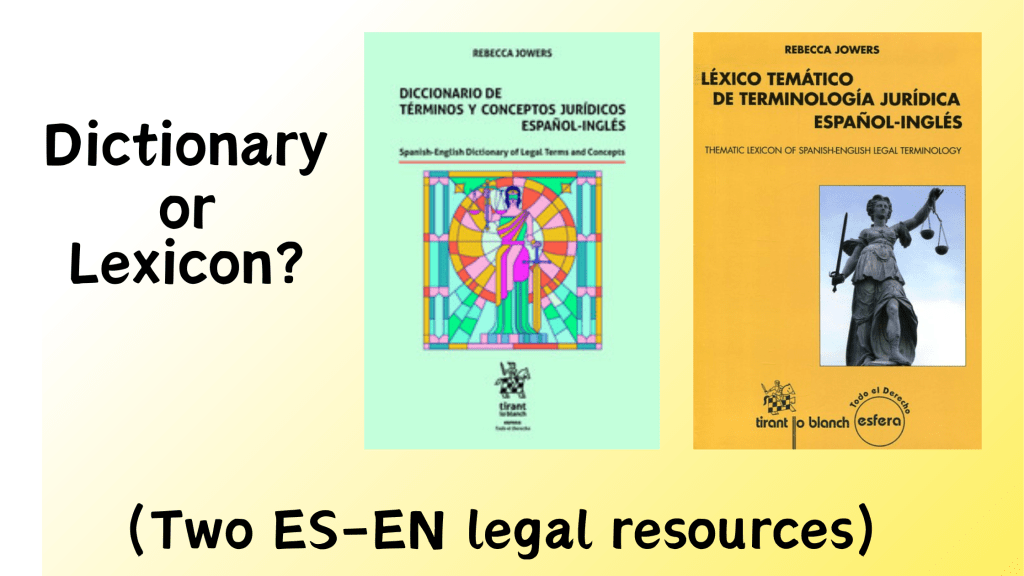
Given their different focus, it’s difficult for me to make a recommendation, so I’m providing here a description of each, along with downloadable pdfs containing samples of the content of each.

LÉXICO TEMÁTICO DE TERMINOLOGÍA JURÍDICA, ESPAÑOL-INGLÉS

(THEMATIC LEXICON OF SPANISH-ENGLISH LEGAL TERMINOLOGY)

The Léxico contains over 20,000 legal terms, expressions and concepts from 15 areas of Spanish law with their corresponding English translations. Over a ten-year period I took notes from the major textbooks used in Spanish law schools in each of the practice areas, culling them for the essential legal terminology and concepts. Presenting this as a lexicon rather than a dictionary allowed me to offer this terminology in the context in which it appears in Spanish legal documents in a two-column format in which the original Spanish is accompanied by one (or more) possible English renderings. I originally conceived this as a tool for intensive translator-interpreter terminology training, as well as for lawyers and law professors who require an in-depth knowledge of Spanish and English in the major legal disciplines, including:

Derecho y sistema judicial (Law and the Judiciary)

Derecho procesal civil (Civil Procedure)

Derecho penal (Criminal Law)

Derecho procesal penal (Criminal Procedure)

Derecho penitenciario (Corrections Law)

Derecho del trabajo, Derecho de la Seguridad Social y Derecho procesal laboral (Labor Law, Social Security Law and Labor Procedure)

Derecho tributario (Tax Law)

Derecho de la persona (Law of Persons)

Derecho de los contratos (Contract Law)

Derecho de daños (Tort Law)

Derecho de familia (Family Law)

Derecho de cosas y Derecho inmobiliario registral (Property Law and Property Registration)

Derecho de sucesiones (Law of Succession)

Derecho mercantil (Business Law—includes Derecho societario, i.e., Corporate Law and Law of Business Organizations)

Here is a pdf with a sample of the Léxico’s content (68 pages. It can be read directly in this post or downloaded via the button below):

The Léxico is available here in both print and in ebook from the Tirant lo Blanch legal publishers.

DICCIONARIO DE TÉRMINOS Y CONCEPTOS JURÍDICOS, ESPAÑOL-INGLÉS

(SPANISH-ENGLISH DICTIONARY OF LEGAL TERMS AND CONCEPTS)

With almost 30,000 entries, the Diccionario includes the terminology and concepts contained in the Léxico along with content from my personal legal translation glossaries compiled during my 45-year career as a legal translator and professor of Legal English in the Máster de Asesoría Jurídica de Empresas programa at the Universidad Carlos III in Madrid. Each entry includes an indication of the area of law in which the term is used, one or more possible translations or a brief definition if there is no functional equivalent in English, plus synonyms for the term, if any. The dictionary format enabled me to include terminology from many other legal practice areas in addition to the 15 areas of law covered in the Léxico, including:

Arbitraje (arbitration)

Auditoría (auditing)

Ciencia forense (forensics)

Contabilidad empresarial (business accounting)

Derecho (general) (terms used in several practice areas) (law—general)

Derecho administrativo (administrative law)

Derecho aduanero (customs law)

Derecho bancario (banking law)

Derecho civil (civil law)

Derecho concursal (insolvency law)

Derecho constitucional (constitutional law)

Derecho de aguas (water law)

Derecho de autor (copyright)

Derecho de cosas (property law)

Derecho de daños (tort law)

Derecho de extranjería (immigration law)

Derecho de familia (family law)

Derecho de la competencia (competition law)

Derecho de la competencia desleal (unfair competition)

Derecho de la persona (law of persons)

Derecho de la publicidad (advertising law)

Derecho de la Seguridad Social (social security law)

Derecho de la Unión Europea (EU law)

Derecho de las obligaciones (law of obligations)

Derecho de los consumidores (consumer protection)

Derecho de los contratos (contract law)

Derecho de los seguros privados (insurance law)

Derecho de los títulos valores (negotiable instruments)

Derecho de los transportes (transportation law)

Derecho de marcas (trademark law)

Derecho de patentes (patent law)

Derecho de sucesiones (law of succession)

Derecho del mercado de valores (securities law)

Derecho del trabajo (labor law)

Derecho electoral (electoral law)

Derecho internacional (international law)

Derecho marítimo (maritime law)

Derecho medioambiental (environmental law)

Derecho notarial (law of public notaries)

Derecho penal (criminal law)

Derecho penitenciario (corrections law)

Derecho presupuestario (budgetary law)

Derecho procesal (general) (procedure—general)

Derecho procesal civil (civil procedure)

Derecho procesal laboral (labor procedure)

Derecho procesal penal (criminal procedure)

Derecho registral (law of public registers)

Derecho societario (corporate law; law of business organizations)

Derechos humanos (human rights)

Economía (economics)

Ejercicio de la abogacía (legal practice)

Finanzas (finance)

Formación jurídica (legal education)

Fraseología jurídica (common expressions found in legal texts and contracts) (legal phraseology)

Incoterms (incoterms)

Operaciones comerciales—general (commercial transactions—general)

Propiedad intelectual e industrial (intellectual property)

Protección de datos (data protection)

Sistema judicial (judicial system; organization of courts)

Urbanismo (urban planning)

Here is a pdf with a sample of the Diccionario’s content (75 pages). It can be read directly in this post or downloaded using the button below:

The Diccionario is available here in both print and in ebook from the Tirant lo Blanch legal publishers.

False Friends in ES-EN Legal Translation: “inhibición” vs. inhibition

Just a short post here to underscore that in Spanish procedural terminology inhibición has a peculiar meaning totally unrelated to “inhibition,” denoting a judge’s declining or relinquishing jurisdiction over a case in favor of another court. Thus, for example, el TSJ de Madrid se inhibió en el “Caso Gürtel” a favor de la Audiencia Nacional indicates that “The Superior Court of Justice of Madrid declined (or) relinquished its jurisdiction in the Gürtel case in favor of the National Court.”

In this context inhibición is often confused with abstención and recusación. How the related terms abstención, recusación, inhibición and declinatoria are used in procedural contexts is explained in detail here.)

Guidelines for Giving a Presentation in English

Speaking skills are perhaps the most difficult to acquire when learning a new language, and my Legal English students have often said that giving a formal presentation is the most difficult of all. I put together these Guidelines for their use, and I’m posting them here in case they may prove useful to others. At the end there is a “Rate Yourself” chart for assessing overall effectiveness.

Guidelines for Giving a Presentation in English

BEFORE YOUR PRESENTATION

  • Define your audience
  • Plan the content
  • Use your own words
  • Prepare handouts or other visual aids
  • DO NOT USE GOOGLE TRANSLATE OR SIMILAR APPS to prepare your presentation (the results may be a disaster!)

DURING YOUR PRESENTATION

  • Keep it simple
  • Follow a clear structure
  • Look directly at your audience
  • Project your voice
  • DO NOT READ

USEFUL LANGUAGE

1. Introducing your topic

  • This morning/today…
  • I’m going to talk about…
  • I’d like to describe…
  • The topic of my presentation is…
  • This morning I’d like to give you an overview of…
  • The theme of my talk is…
  • My presentation this morning concerns…
  • This afternoon I would like to talk to you about…
  • I will be examining the following areas…
  • This presentation focuses on the issue of…

2. Preliminary outline of your presentation

  • First,/Second,/Then,/After that,/Finally,
  • I’d like to… deal with…/move on to…/focus on…/consider…
  • First, I’m going to look at …
  • Second, I’ll move on to the issue of …
  • Then I’ll examine …
  • Lastly/Finally, I’ll look at / focus on …
  • My presentation is divided into/I’ve divided my talk into… (three/four parts…)
  • I have divided my talk into the following main areas: …
  • I am going to divide my presentation into two main parts. First I’m going to describe… and then I’ll move on to look at …

3. Referring to questions

  • Feel free to interrupt me if you have a question.
  • If you don’t mind, we’ll leave questions until the end.

4. Introducing each section

  • Let’s start with… (objectives)
  • First we’re going to look at…
  • I’d like to begin by…
  • Now I’d like to focus on…
  • I’d like to mention three points here…
  • Now let’s move on to … (the next part)
  • Let’s turn our attention to… (the question of…)
  • This leads me to… (my third point…)
  • Finally… (let’s consider…)

5. Making reference to other sections of the presentation

  • As I mentioned earlier…
  • I’ll say more about this later.
  • I’ll come back to this point later.

6. Referring to common knowledge

  • As you know…
  • As you may recall/remember…

7. Referring to visual aids (handouts, powerpoints, etc.)

  • This chart/outline/etc. shows/represents…
  • If you look at this chart/table/etc….
  • I’d like to draw your attention to this diagram/chart/table/etc….
  • The data here shows that…

8. Summarizing main points and making conclusions

  • To summarize, (there are five key points…)
  • In conclusion,…
  • To conclude my presentation, I would like to…

RATE YOURSELF

How was your presentation?

 ExcellentGoodOKPoor
System
-organization
-knowledge of topic
-introduction
-ending
-connections
-relevance
-length
-level  
    
Manner
-audience contact
-interest
-assurance
-confidence  
    
Body Language
-stance
-posture
-hands
-eye contact
-movement
-facial expression  
    
Visual aids
-number
-design
-relevance
-usefulness  
    
Overall impression      

ES-EN Legal Translation: Multiple Meanings of “Remand”

Remand means “to send back, to remit or to consign again.” In legal usage “remand” is used in at least two separate instances. In appellate procedure “remand” refers to sending a case back to the trial court for further action consistent with the appellate court’s decision. This occurs, for example, when an appellate court reverses a trial court’s opinion and remands the case for a new trial. In Spanish the idea of remanding a case (i.e., sending it back to the lower court) is expressed as retrotraer (or) reponer las actuaciones. Thus, an appellate order such as “We reverse and remand for new trial” may be expressed as Anulamos la sentencia recurrida, retrotrayendo (or) reponiendo las actuaciones al momento anterior al juicio oral, debiendo celebrarse un nuevo enjuiciamiento.

In a second meaning remand refers to recommitting an arrestee to custody after some type of preliminary hearing before the court. For example, at a bail hearing, if bail is denied, the judge will order that the defendant be “remanded in custody.” This is often expressed in Spanish with the peculiar expression elevar la detención a prisión provisional (literally, to convert the initial arrest to pretrial detention or custody). And, especially in British usage, pretrial detainees (persons held in pretrial detention) are known as “remand prisoners,” while time spent in pretrial custody is “time spent on remand.”

“Translating ‘Derecho Penal'” at ATA65 Portland

I’ll be giving an AST (Advanced Skills & Training) session at the American Translators Associations annual conference in Portland on October 30. For those who might be interested in attending, here is a description of the session with an outline of the aspects of Derecho Penal that we will be discussing.

ATA65 Portland—AST Session (AST-05)

Translating Derecho Penal

(Concepts and Terminology from a Comparative Law Perspective)

Drawing on examples from the códigos penales of Spain and Mexico as well as the Model Penal Code, Title 18 US Code and other US state codes, this session seeks to provide a comprehensive overview of the concepts and terminology of Derecho penal from a common law viewpoint. We will focus on terms that legal T&Is may encounter as well as the major translation pitfalls found in criminal law documents, exploring the following aspects:

  • How criminal law is organized in Spanish-speaking jurisdictions: la Parte General (criminal law theory) vs. la Parte Especial (specific offenses and how they are defined and may be translated)
  • Principios del Derecho Penal (general principles of criminal law)
  • Teoría del Delito: a few essential concepts:
  • Definición del delito: the German model adopted in Spanish-speaking jurisdictions vs. the common law actus reus / mens rea elements
  • Understanding (and translating) tipicidad, antijuridicidad, culpabilidad and punibilidad
  • Clasificación de los delitos (how crimes are classified)
  • Other key concepts: acción y omisión; bien jurídico protegido; dolo vs. culpa; causalidad
  • Iter criminis (the road to crime): fases en la realización del hecho típico
  • impunidad del mero pensamiento: thinking isn’t a crime
  • actos ejecutivos: overt acts requirement; substantial steps toward the commission of a criminal offense
  • inchoate (preparatory or imperfect) crimes: conspiración (conspiracy); proposición (criminal solicitation); provocación (incitement to crime)
  • tentativa de delito (criminal attempt)
  • Autoría del delito (perpetration of criminal offenses)
  • Participación en el delito (aiding and abetting the commission of a crime)
  • complicidad (types of accomplice liability)
  • Teoría de la pena (theory of punishment)
  • Circunstancias modificativas de la responsabilidad criminal: agravantes; atenuantes y eximentes (aggravating, mitigating and exonerating circumstances; perfect and imperfect defenses)
  • Clases de pena (types of criminal sentences): penas privativas de libertad (custodial sentences) vs. penas no privativas de libertad (noncustodial sentences)
  • Determinación y aplicación de la pena (sentencing) and execución de la pena (execution / enforcement of sentences)
  • Translating specific offenses:
  • Homicidio vs. asesinato (when is it murder?)
  • Amenazas y lesiones (not exactly assault and battery?)
  • Violación; agresión sexual (translating sexual offenses)
  • Allanamiento de morada (breaking and entering, or mere trespass?)
  • Criminal defamation (distinguishing injurias and calumnias)
  • Hurto vs. robo (when is it theft, robbery or burglary?)
  • Delito de daños (criminal damage to property)
  • Cohecho (bribery)
  • Malversación (ES); peculado (MX) (embezzlement)
  • (others)
  • Wrap-up and recap: a look at problematic criminal law concepts and terminology pitfalls
  • Same Thing, Different Name: criminal law terminology in Spain and Mexico

Attendees will receive a bilingual-glossary of the criminal law terms discussed and additional translator/interpreter resources.

False Friends in ES-EN Legal Translation: “legitimación” vs. legitimation

These terms are clearly “false friends.” In English “legitimation” is a family law term, generally referring to the legitimation of an illegitimate child through the marriage of their parents or, in jurisdictions where it is required, acknowledgment by the child’s father. In Spanish family law, voluntary legitimation of a nonmarital child is expressed as reconocimiento de paternidad (“acknowledgment of paternity”), but may also be the result of an acción de filiación (“paternity suit”) in which a sentencia firme de paternidad (“paternity judgment;” “judgment of paternity”) has been rendered.

In contrast, in Spanish legitimación is a totally unrelated civil procedure term that is often mistranslated literally as “legitimation.” In this context legitimación actually refers to what in Anglo-American law is termed “standing” (or locus standi), i.e., the right to bring an action or to challenge a decision in court. Thus legitimación procesal is “standing to sue or be sued,” while legitimación activa specifically describes the “plaintiff’s standing” or “standing to sue,” while legitimación pasiva is the “defendant’s standing” or “standing to be sued.” In this context, excepción de falta de legitimación is a “motion to dismiss for lack (or) want of standing”. And, in an additional example from Spanish inheritance law, legitimación para pedir la partición denotes “standing to demand the division of an inherited estate” among the coheirs.

In other contexts legitimación may likewise denote “authentication.” Thus an expression such as legitimación de la firma refers to “authentication of a signature” or “signature authentication.” And legitimación de capitales is sometimes used as a synonym for blanqueo de capitales (“money laundering”).

Thus, in the examples shown above legitimación cannot be appropriately rendered as legitimation. But can legitimación perhaps be translated as “legitimacy”? I’ve found at least one instance in which this may be possible: when referring to land registration legitimación registral may perhaps be rendered as “legitimacy of registration,” being the presumption that entries on the Registro de la Propiedad are accurate and that rights recorded on the register actually belong to the registered titleholder.

Legal Look-alikes: “minutas” vs. minutes

Although these terms might appear to be related, minutas should not be confused with “minutes.” When “minutes” refers to a document in which proceedings are formally recorded, it is appropriately rendered as acta. In this sense the term is used in expressions such as “minutes of the meeting” (acta de la reunion); “minutes of the annual shareholders’ meeting” (acta de la junta general); “minute(s) book” (libro de actas) or “to take the minutes of the meeting” (levantar acta de la reunión).

In contrast, in Spanish minuta has several legal meanings that are totally unrelated to “minutes.” For example, minuta often refers to a “proposal” or “draft” document, being a synonym of borrador. In the expression minuta del acta de la sesión pendiente de aprobación the term minuta has the meaning of “draft” or “proposal” and denotes the “draft minutes of the meeting pending approval.” Similarly, the attorney for a client who wishes to have a contract or other document recorded in a notarial instrument (escritura) often prepares a minuta para el notario stating all of the basic facts that the notary should include in the document. The notary then uses that minuta (“draft” or “proposal”) to prepare the escritura to be signed by the parties to the transaction. Thus, an expression such as queda redactada la presente escritura conforme a minuta indicates that the notarial instrument was “drawn up in accordance with the draft document” submitted by the notary’s client.

Likewise, in Spain certain court orders are often drafted by the court clerk (formerly, secretario judicial and now known as letrado de la administración de justicia—LAJ) to be approved and signed by the judge. These “draft court orders” or propuestas de resolución are also known as minutas.

And in other respects, minuta may also be a synonym of factura, denoting an itemized “invoice” or “bill.” Thus, for example, a minuta del abogado (a lawyer’s itemized bill for services rendered) may include honorarios (“attorney’s fees” or “legal fees”), suplidos (“disbursements”), aranceles (“fees”) and impuestos (“taxes”). In this context minutación is “billing”, which can include minutación por horas (“billing by the hour”) or minutación por gestión o asunto (often termed in English“flat fee billing”). In this context minuta has sometimes been mistranslated as “legal fees” or “attorney’s fees.” But as underscored above, minuta actually refers to the lawyer’s invoice or bill, which will certainly include, among other charges, his “legal fees” or “attorney’s fees” (called honorarios in Spain).

Legal English for Spanish Speakers: Labor and Employment Law Vocabulary

While working on some ideas for webinars for ES-EN-ES translators, I came across a file containing labor law vocabulary previously used with my students of Legal English at the Universidad Carlos III. Since it has terms that translators may need when rendering labor-related terminology into English, I’m posting it here.

Note: There may be several other possible translations for each of these expressions, and it goes without saying that there are rarely any true equivalents when rendering English terms into Spanish.

employer (empleador)employee (empleado)
employment contract/agreement (contrato laboral; contrato de empleo)
full-time/part-time contract (contrato a tiempo completo/contrato a tiempo parcial)
self-employment (trabajo autónomo; trabajo por cuenta propia)

conditions of employment (condiciones laborales)
to hire (US)/to engage (UK)/to employ an employee (contratar a un empleado)
probation; probationary period (período de prueba)
probationary employee (empleado en período de prueba)
status employee (empleado que ha superado el período de prueba)
full-time employee (empleado/trabajador a tiempo completo)
part-time employee (empleado/trabajador a tiempo parcial)
seniority (antigüedad)

discharge/dismissal (despido)
to discharge/to dismiss/ “to fire” (US)/ “to sack” (UK) an employee (despedir a un empleado)
wrongful dismissal (despido improcedente)
reinstatement (readmisión de un empleado despedido)

vocational/occupational training (formación profesional)
on-the-job training; onsite training (formación en el lugar de trabajo)
offsite training (formación fuera del lugar de trabajo)
promotion (ascenso; subida de categoría laboral)
demotion (descenso; bajada de categoría laboral)
job mobility (movilidad laboral)

labor/trade union (sindicato)
union dues (cuota sindical)
fair share fee (canon de negociación—cuota que pagan los no afiliados al sindicato beneficiados por un convenio colectivo)
collective bargaining (negociación colectiva)
collective bargaining agreement/contract; labor agreement/contract (convenio colectivo)
no strike-no lockout clause (cláusula de paz social)

labor/industrial (UK) dispute (conflicto laboral)
lockout (cierre patronal)
strike (huelga)
sit-in strike (ocupación de talleres; huelga de brazos caídos)
slowdown/go-slow strike (huelga de bajo rendimiento; ralentización de producción—my students from Colombia call this “operación tortuga”)
walk-out strike (abandono de talleres; abandono del lugar de trabajo)
work-to-rule strike (huelga de celo)
sympathy strike (huelga de solidaridad)
wildcat strike (huelga salvaje)
strikebreaker; “scab” (US); “blackleg” (UK) (“rompehuelgas,” “esquirol”—Spain)
picketing; picket (piquete)

wages (salario)
salary (sueldo)
minimum wage (salario mínimo)
cost-of-living index—COL (índice del coste de la vida—ICV)
consumer price index (índice de precios al consumo—IPC)
hours of work (horas laborables)
work week (semana laboral)
work schedule (horario de trabajo)
flextime (horario flexible)

shift work (trabajo a turnos; turnicidad)
to work shifts; to do shift work (trabajar a turnos)
work shift (turno de trabajo)
day shift/night shift (turno de día/turno de noche)
shift differential; differential pay (plus de turnicidad; suplemento salarial por trabajo a turnos)

overtime (horas extras; horas extraordinarias)
overtime pay (horas extras remuneradas/retribuidas; horas extraordinarias remuneradas/retribuidas)
compensatory time; comp time (compensación [de horas extras] por tiempo equivalente de descanso retribuido)

day off (día libre)
vacation (US)/holiday (UK) pay; paid vacations (US)/holidays (UK) (vacaciones remuneradas/retribuidas)
backpay (salarios atrasados/devengados y no pagados)

leave (permiso; baja; excedencia)
personal leave (permiso por asuntos personales)
sick leave (baja por enfermedad)
maternity leave/paternity leave; parenting leave (baja por maternidad/paternidad)
family leave (permiso por asuntos familiares)
bereavement leave (permiso por defunción)

retirement fund (US)/retirement scheme (UK) (fondo de pensiones)
retirement pension (pensión de jubilación)
unemployment benefits (prestación por desempleo)
workers’ compensation; workers’ comp (US); industrial injury compensation (UK) (prestación por accidente laboral)
occupational (US)/industrial (UK) accident (accidente laboral)
occupational (US)/industrial (UK) disease (enfermedad laboral/enfermedad profesional)
occupational safety and health; safety and health in the workplace (seguridad y salud laboral; seguridad y salud en el trabajo)
job safety (seguridad en el trabajo) vs. job security (estabilidad laboral)

Upcoming ATA Webinar: Translating Spanish Corporate Documents

Next Tuesday (April 16) I’ll be giving an hour-long (maybe more!) webinar for the American Translators Association on

“Translating Spanish Corporate Documents: 10 Common Pitfalls”

For colleagues who have asked about the specific content, here are the topics I will be covering:

  1. The Main Five—standard corporate forms in Spanish-speaking jurisdictions (and possible translations)
  2. The basics (translating sociedad, socio, social and societario)
  3. Invented and all-too-literal translations
  4. Two important ellipses
  5. False friends in corporate terminology
  6. Weird stuff
  7. Tricky expressions
  8. Stylistic considerations: Mayúsculas gone wild! and verb tenses in Spanish corporate minutes
  9. “Same thing, different name:” terminological variations in Spain and Latin America
  10.  US vs UK corporate terminology

The webinar is scheduled for 12 pm EDT. For more details, see here:

Artificial Intelligence for Translators and Interpreters

I recently took a 10-hour Zoom course on “Artificial Intelligence for Translators and Interpreters,” taught by Nora Díaz (a born teacher) and offered by Fernando Cuñado and Ruth Gámez on their Academia de los Grandes Traductores platform. For me it was a perfect introduction to how AI can have a positive impact on T&I work.

Nora logically commenced with an overview of AI and large language models, initially highlighting the AI capabilities integrated into Microsoft Suite and Google Suite. She then demonstrated how ChatGPT, Gemini, and Copilot can work as “interns” to assist translators and interpreters in automating multiple tasks (including terminology extraction and glossary building), and how to draft effective prompts to get the desired results. Nora demonstrated that much of this can be even further automated with PhraseExpress.

The session on AI and CAT tools focused on Wordscope (the first CAT tool with ChatGPT integration), as well as how to set up and use the Trados Studio AI Professional plug-in. Apps specifically for interpreters were also reviewed, featuring real-time transcription, including Cymo Booth and Cymo Note. Each day practice exercises were provided to do together in class, although the sessions were recorded and are available for future viewing. The course was in English but Nora and Fernando have promised future editions in both Spanish and English, too.