“Return” is used in several legal contexts in which it cannot be translated literally with its everyday meaning of volver. As a noun and in the context of electoral law, the expression “election returns” refers to resultados electorales. But, curiously, as a verb rather than “to elect,” “return” actually means “to reelect:” “The candidate was returned by a majority” (El candidato fue reelegido por mayoría).
In the context of tax law “tax return” refers to la declaración de la renta, and “to file a tax return” is presentar la declaración de la renta. (Perhaps it should be noted that “tax return” has sometimes been mistranslated as devolución de impuestos, devolución de la renta or devolución de Hacienda, which are expressions more appropriately rendered as “tax refund.”)
In other respects, in US criminal procedure and in the context of jury trials, the expression “to return a verdict” means emitirun veredicto.” Thus the expression “the jury returned a verdict of guilty” denotes that el jurado emitió un veredicto de culpabilidad.
I’ve added a new category to this blog (Vocabulary Building) where I will be posting Spanish-English mini-glossaries of legal terms that I think may be of interest to translators and interpreters. This first one posted below contains over 150 terms and concepts from Spanish Trademark Law, many collected during the four years that I worked as an in-house translator in the Trademark Department at Elzaburu (Spain’s leading intellectual property law firm).
Spanish-English Glossary of 150 Trademark Law Terms
acuerdo de coexistencia–trademark coexistence agreement
acuerdo de delimitación de marca–trademark delimitation agreement
agotamiento de derechos de marca–exhaustion of trademark rights
ampliación de productos–extension of goods (covered under a trademark registration)
Arreglo de Lisboa relativo a la Protección de las Denominaciones de Origen y su Registro Internacional–Lisbon Agreement for the Protection of Appellations of Origin and their International Registration
Arreglo de Madrid relativo al Registro Internacional de Marcas–Madrid Agreement Concerning the International Registration of Marks
aviso de parecidos–opposition watch service notice (notice of confusingly similar marks found in a trademark availability search)
búsqueda de antecedentes registrales–trademark availability search (for prior confusingly-similar trademark registrations) (syn: búsqueda de parecidos; investigación de parecidos/antecedentes registrales)
búsqueda de identidades–trademark availability search (for prior identical trademark registrations)
búsqueda de parecidos–trademark availability search (for prior confusingly-similar trademark registrations) (syn: búsqueda de antecedentes registrales; investigación de parecidos/antecedentes registrales)
caducidad de la marca por falta de uso–lapse of a trademark for nonuse
cartera de marcas–trademark portfolio
certificado de registro–trademark registration certificate; certificate of trademark registration
cesión de marca–trademark assignment; assignment of trademark
Clasificación de Niza (nombre alternativo de la Clasificación Internacional de Productos y Servicios)–Nice Classification (alternate name of the International Classification of Goods and Services)
Clasificación de Viena (nombre alternativo de la Clasificación Internacional de Elementos Figurativos de las Marcas)–Vienna Classification (alternate name of the International Classification of Figurative Elements of Trademarks)
Clasificación Internacional de Elementos Figurativos de las Marcas (también denominada Clasificación de Viena)–International Classification of Figurative Elements of Marks (also known as the Vienna Classification)
Clasificación Internacional de Productos y Servicios (también denominada Clasificación de Niza)–International Classification of Goods and Services (also known as the Nice Classification)
coexistencia de marcas similares o idénticas–coexistence of similar or identical trademarks
distintividad marcaria adquirida–acquired distinctiveness; secondary meaning (syn: distintividad sobrevenida)
distintividad marcaria sobrevenida–acquired distinctiveness; secondary meaning (syn: distintividad adquirida)
elemento de la marca–trademark component
elemento gráfico de la marca–visual component; design element (device marks)
enunciado de productos–specification of goods
enunciado de servicios–specification of services
examen de fondo–substantive examination (of a trademark application to determine whether the applicant mark is registrable)
examen de forma–preliminary examination (of a trademark application to determine whether the application complies with formal and legal requisites)
falta de distintividad–lack of distinctiveness
falta de uso–nonuse; failure to use (a trademark)
fecha de prioridad–priority date
fidelidad a la marca–brand loyalty
Gaceta de la OMPI de Marcas Internacionales–WIPO Gazette of International Marks
genericidad–genericness
inducir a la confusión–to prompt confusion; to lead to confusion (between confusingly-similar trademarks)
informe de búsqueda–trademark availability search report
infracción de derechos de marca–trademark infringement (syn: violación de derechos de marca)
investigación de antecedentes registrales–trademark availability search (search for prior confusingly-similar trademark registrations) (syn: investigación de parecidos; búsqueda de parecidos; búsqueda de antecedentes registrales)
investigación de parecidos–trademark availability search (search for prior confusingly-similar trademark registrations) (syn: investigación de antecedentes registrales; búsqueda de parecidos; búsqueda de antecedentes registrales)
Ley de Marcas–Trademark Act
licencia de uso de marca–trademark license
marca–mark; trademark; trade mark (UK)
marca anterior–earlier mark
marca blanca–house brand; store brand; private label; generic brand (syn: marca de distribuidor)
marca caducada–lapsed mark
marca colectiva–collective mark
marca comunitaria–Community trade mark (former name of the European Union trade mark–now, marca de la Unión Europea)
marca consolidada–incontestable mark (syn: marca inatacable)
marca contraria al orden público o a las buenas costumbres–trademark contrary to public policy or accepted moral principles
marca de base–basic mark (trademark that serves as the basis for filing an international trademark application with the International Bureau at the World Intellectual Property Organization, WIPO)
marca de color–color mark
marca de distribuidor–house brand; store brand; private label; generic brand (syn: marca blanca)
marca de fantasía–fanciful mark
marca de garantía–certification mark
marca de la Unión Europea–European Union trade mark
marca de movimiento–motion mark
marca de patrón–pattern mark
marca de posición–position mark
marca de servicio–service mark
marca defensiva–defensive mark; defensive registration
marca denominativa–word mark
marca descriptiva–descriptive mark
marca engañosa–misleading mark
marca genérica–generic mark; genericized mark
marca gráfica–device/design mark
marca gustativa–taste mark
marca holograma–hologram mark
marca inatacable–incontestable mark (syn: marca consolidada)
marca internacional–international trademark registration
marca mixta–composite mark
marca multiclase–multi-class mark
marca multimedia–multimedia mark
marca notoria–well-known trademark (trademark known to consumers in the sector)
marca olfativa–smell/scent/olfactory mark
marca oponente–opposing mark
marca pretendiente–applicant mark (syn: marca solicitada; marca solicitante)
marca prioritaria–prior mark; earlier mark
marca publicitaria–slogan mark
marca que falta distintividad–non-distinctive trademark
marca registrada–registered trademark
marca renombrada–renowned trademark (trademark known to the public in general)
marca solicitada–applicant mark (syn: marca pretendiente; marca solicitante)
marca solicitante–applicant mark (syn: marca pretendiente; marca solicitada)
marca sonora–sound/aural mark
marca táctil–tactile/touch/texture/haptic mark
marca tridimensional–three-dimensional/shape mark
marcario–pertaining to trademarks
marcas confrontadas–conflicting trademarks
marcas confundibles–confusingly similar trademarks (syn: marcas incompatibles; marcas similares que conducen a confusión)
marcas idénticas–identical trademarks
marcas incompatibles–confusingly similar marks (syn: marcas confundibles; marcas similares que conducen a confusión)
marcas similares que conducen a confusión–confusingly similar marks (syn: marcas confundibles; marcas incompatibles)
motivo absoluto de denegación–absolute grounds for refusing registration (EU trade mark)
nombre genérico–generic name
Nomenclátor Internacional de Productos y Servicios (Clasificación de Niza)–International Classification of Goods and Services (Nice Classification)
oposición a la solicitud de marca–opposition to a trademark application (filed on behalf of the owner of a prior mark)
pérdida de distintividad–loss of distinctiveness
prioridad de exposición–exposition priority
prioridad reivindicada–priority claimed
probabilidad de confusión–likelihood of confusion (of confusingly similar trademarks)
prohibición absoluta de registro–absolute grounds for refusing trademark registration
prohibición relativa de registro–relative grounds for refusing a trademark registration
Protocolo concerniente al Arreglo de Madrid relativo al Registro Internacional de Marcas (Protocolo de Madrid)–Protocol Relating to the Madrid Agreement Concerning the International Registration of Marks (Madrid Protocol)
prueba de uso de la marca–proof of trademark use
reconocimiento de marca–trademark recognition; brand awareness
registro de base–basic registration (trademark registration that serves as the basis for filing an international trademark application with the International Bureau at the World Intellectual Property Organization–WIPO)
Registro Internacional–International Register (of international trademarks)
rehabilitación de una marca–reinstatement of a trademark
reivindicación de antigüedad–seniority claim
reivindicación de prioridad–priority claim
renovación de la marca–renewal of a trademark
renuncia de la marca–surrender of a trademark; waiver of trademark rights
representación gráfica–graphical representation
requisito de uso–trademark use requirement
restablecimiento de derechos de marca–reinstatement of trademark rights
riesgo de confusión–likelihood of confusion (of confusingly similar trademarks)
rótulos de establecimiento–business signs; business signage
signo distintivo–distinctive sign (in Spain these include trademarks –marcas– and tradenames–nombres comerciales)
similitud gráfica–similarity in design (device marks)
solicitud de base–basic application (trademark application that serves as the basis for filing an international trademark application with the International Bureau at the World Intellectual Property Organization–WIPO)
solicitud de marca–trademark application
suspensión de la solicitud–suspension of a trademark application
titular de la marca–trademark owner
uso obligatorio de marca–mandatory use of a trademark; mandatory trademark use
uso real y efectivo de la marca–real and effective use of a trademark
violación de derechos de marca–trademark infringement (syn: infracción de derechos de marca)
Prestación and prestar have many different meanings in legal contexts. Prestar appears in several common expressions such as prestar consentimiento (“to consent” or “to give consent”), prestar servicios (“to provide services”), prestar juramento (“to take an oath”), prestar caución (“to post a bond”) or prestar fianza (“to post bail”). Prestación is used similarly in these same expressions: prestación de servicios (“provision of services), prestación de juramento (“taking an oath”), prestación de fianza (“posting bail”), etc.
In the law of obligations (Derecho de obligaciones), prestación refers either to “performance” owed or to a “payment” that is due, while in the context of labor law (Derecho laboral) prestación extrasalarial denotes a “fringe benefit” or “perk” afforded employees.
Prestación is likewise rendered as “benefit” when referring to protections provided through a social security system: prestación de la Seguridad Social (“social security benefit”). Common examples include, among others, prestación por desempleo (“unemployment benefit”), prestación por jubilición (“retirement benefit”), prestación por hijo a cargo (“dependent child benefit”) and prestación por accidente laboral, known as “industrial injuries disablement benefit” in the UK, but called “workers’ compensation” in the US.
There are at least two instances in legal contexts in which administrador and “administrator” may be false cognates. In the context of corporate law, administrador does not generally refer to an “administrator,”·but rather to a company “director.” For example, in Spain business entities may choose among four possible corporate management structures. Management may be entrusted to an administrador único (“sole director”), two or more administradores mancomunados (“joint directors;” “directors acting jointly”), administradores solidarios (“joint and several directors;” “directors acting jointly and severally”) or a consejo de administración (“board of directors”), which may be called a directorio or junta directiva in other Spanish-speaking jurisdictions. In that regard, “directors” are known variously as consejeros or “board members” or “members of the board” (miembros del consejo, miembros del directorio or miembros de la junta directiva).
In other respects, in English and in the context of inheritance law (Derecho de sucesiones), a person appointed by a court to settle the estate of an intestate decedent (causante que ha muerto intestado) or of a decedent testator who failed to appoint an executor (albacea) is known as an “administrator” (called albacea judicial or albacea dativo in Spanish). It is worth noting that formerly “administrator” denoted a male court-appointed executor of a will, while if that task were performed by a woman, she was known as an “administratrix” (plural: “administratrixes,” or “administratrices”), terms that have now largely fallen in disuse.
It is easy to assume that recurrir and apelar are synonyms, and recurso and apelación do indeed appear as such in many bilingual sources that inevitably translate both as “appeal.” However, they are not interchangeable. Recurso is a broad term denoting generically many types of appeals and legal remedies, both judicial and administrative. Thus, recurso may be a general term for “appeal,” or it may denote a specific means of appeal, depending on the context.
In contrast, (recurso de) apelación is a specific type of appeal (in Spain is known as a recurso devolutivo, or appeal to a higher court) from (or against) the decision of a trial court (tribunal de primera instancia), whether civil, criminal, administrative or labor. In that regard, recurso de apelación may perhaps be described as a “second instance appeal,” an “appeal of a trial court’s decision,” or perhaps as an “appeal to an intermediate appellate court,” but only in those instances in which a further appeal may be available if the apelación is unsuccessful. Verbs denoting the filing of a recurso de apelación are apelar or recurrir en apelación.
WordPress tells me that 42,531 people viewed my blog content during 2023. I am quite aware that’s hardly a drop in the bucket for many sites. But it may actually be a lot for this ES-EN legal translation niche, and encourages me to continue to add new entries in 2024. I say this because, not long ago, a lawyer-linguist colleague suggested that my type of language-specific content is no longer of much interest to translators and interpreters. He suggested that the focus has now turned to other more technical topics, such as how to run a translation business, translator and interpreter training, the use of plain or inclusive language, or the impact of AI on T&I, among others.
But I still have lots of ideas concerning the linguistic aspects of legal translation that I want to add to my 300 already-published blog entries in the upcoming months. They will still be organized in the same categories that I invented when commencing the blog in 2016:
False Friends (yes, I admit I’ve been called la loca de los falsos amigos)
Multiple Meanings (Polysemy)
Confusing Terms
Frequent Mistranslations
Español Jurídico
Common Terms with Uncommon Legal Meanings
Expressing Spanish Civil Law Concepts in Common Law Terms
When “board” denotes a group of persons exercising managerial or supervisory powers, it can have several different Spanish renderings. In business law contexts in Spain, a company’s “board of directors” is its consejo de administración (called junta directiva or directorio in other Spanish-speaking jurisdictions). In other respects, the “board of trustees” of a foundation (fundación) is its patronato.
“Board” is also used in the context of alternative dispute resolution (resolución extrajudicial de conflictos), in which arbitration (arbitraje) may be conducted by a single arbitrator (árbitro único) or by a panel of arbitrators commonly known as an “arbitration board” (tribunal arbitral).
In the US, a state or local entity that governs and manages the public school system is commonly know as the “board of education.” And “board” may likewise designate a type of governmental body or entity. In that regard, what in Spain are collectively termed organismos administrativos (generically, “governmental agencies”) receive several different names within the US government. One of these is “board” (Federal Reserve Board–FRB; National Labor Relations Board–NLRB, etc.), but also include “agencies” (Central Intelligence Agency–CIA; Environmental Protection Agency–EPA), “bureaus” (Federal Bureau of Investigation–FBI) and “commissions” (Securities and Exchange Commission–SEC; International Trade Commission–ITC).
These are true false friends, “assassination” (the deliberate killing of a public figure) being magnicidio, while asesinato is generally associated with “murder” (the intentional premeditated unlawful killing of a human being). With respect to the latter, the specific related offenses defined in the Spanish Criminal Code (Código Penal) include homicidio imprudente, homicidio (doloso) and asesinato. How these terms are translated may depend on the target audience, but generally homicidio (doloso), defined as matar dolosamente a otra persona, may perhaps be best rendered simply as “murder.”
In contrast, as defined in Spain asesinato requires killing con alevosía (measures that an offender takes to ensure their impunity), por precio, recompensa o promesa (for hire, reward or promise of reward), or con ensañamiento (with extreme cruelty). Committing murder con alevosía implies depriving the victim of any means of defense (inexistencia de posibilidades de defensa por parte del sujeto pasivo), while ensañamiento is defined as aumentar deliberada e inhumanamente el sufrimiento de la víctima en la ejecución del delito. In view of these requisites, if homicidio (doloso) is rendered as “murder,” asesinato may perhaps be appropriately described as “aggravated murder” or “first-degree murder.” In other respects, homicidio imprudente may possibly be rendered as “manslaughter” (unlawful killing without express or implied intent to do injury), but when a distinction must be made between homicidio imprudente grave and homicidio imprudente leve expressions such as “reckless homicide” and “negligent homicide” may perhaps prove useful.
At a certain age, you start contemplating retirement. (Those of you who know me know that I’m well over retirement age, but I’m not quite there yet.) But looking toward the not-so-immediate future, it occurred to me that the Spanish-English legal terminology glossaries that I’ve compiled over my 40-year career as a legal translator and professor of Legal English might prove useful to others in this field. (These include ES-EN legal translators and interpreters, as well as other legal professionals, such as my translation clients who are either lawyers who have to explain Spanish law in English to their English-speaking clients, or Spanish law professors who lecture and publish in English.)
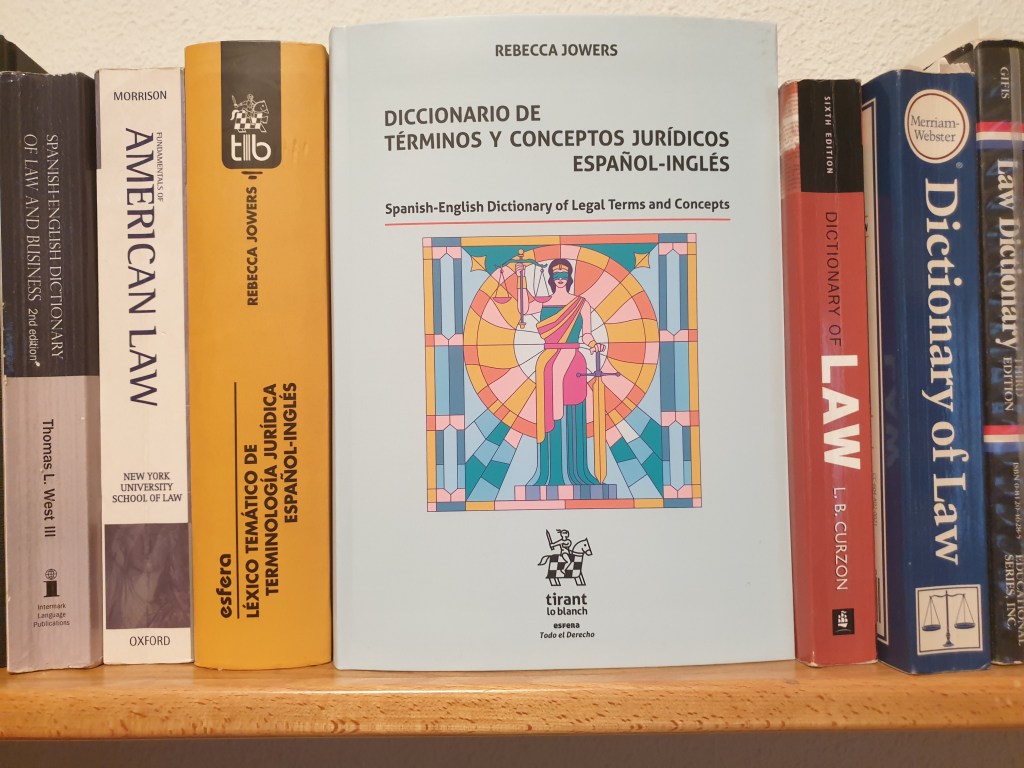
Thanks to the fine work of the Tirant lo Blanch Legal Publishers, my glossaries were just published here as Diccionario de términos y conceptos jurídicos español-inglés in both print and ebook.
But this Dictionary includes terminology from 45 additional fields of law including arbitration, accounting, administrative law, advertising law, auditing, budgetary law, civil law, civil procedure, commercial transactions, competition law, constitutional law, consumer law, contract law, copyright law, corrections law, corporate law and the law of business organizations, criminal law, criminal procedure, customs, economics, electoral law, environmental law, EU law, family law, finance, forensic science, human rights, immigration law, Incoterms, inheritance law, law of succession, insurance law, insolvency law, international law, intellectual and industrial property, law and the judicial system, labor law, labor procedure, legal education, legal practice, maritime law, negotiable instruments, law of public notaries, law of obligations, patent law, law of persons, procedure (general), property law, law of public registers, securities law, social security law, tax law, trademark law, tort law, transportation law, unfair competition, urban planning, water rights and other general terminology.
In legal usage “impertinent” and impertinente can usually be considered false friends. In nonlegal Spanish, impertinente has two possible meanings (taken from the DLE): 1) “que no viene al caso” (in English, “irrelevant”) and 2) “que molesta de palabra o de obra” (in English, “impertinent”).
In Legal Spanish impertinente generally has the first meaning: que no viene al caso; que es irrelevante (and, therefore, the matter in question is improcedente; no procede en Derecho). In the Spanish Law of Evidence there are two clear examples: prueba impertinente and pregunta impertinente. Prueba impertinente is defined as “prueba que no guarda relación con el objeto del proceso” (in Legal English, “irrelevant evidence”). This prohibition of irrelevant evidence is set forth in article 283.1 of the Ley de Enjuiciamiento Civil that provides that “no deberá admitirse ninguna prueba que, por no guardar relación con lo que sea objeto del proceso, haya de considerarse impertinente.”
In that regard, evidence can be classified as prueba pertinente or prueba impertinente (“relevant or irrelevant evidence”), prueba útil or prueba inútil (“material or immaterial evidence,” in the sense of being appropriate or inappropriate for demonstrating the fact that it is intended to prove), and prueba directa or prueba presencial (“direct evidence” or “eyewitness evidence”) as opposed to prueba indirecta or prueba indiciaria (“indirect evidence” or “circumstancial evidence”).
The same applies to preguntas impertinentes (in Legal English, “irrelevant questions”) that may not be used when examining witnesses at trial. The DPEJ defines pregunta impertinente as “cuestión que no deba ser respondida en juicio por el interrogado, al no corresponder con los hechos litigiosos o no guardar relación con el declarante.” And in addition to preguntas impertinentes (irrelevant questions), Spanish Law of Evidence likewise prohibits the use of preguntas sugestivas (“leading questions”) and preguntas capciosas (“misleading or trick questions”).