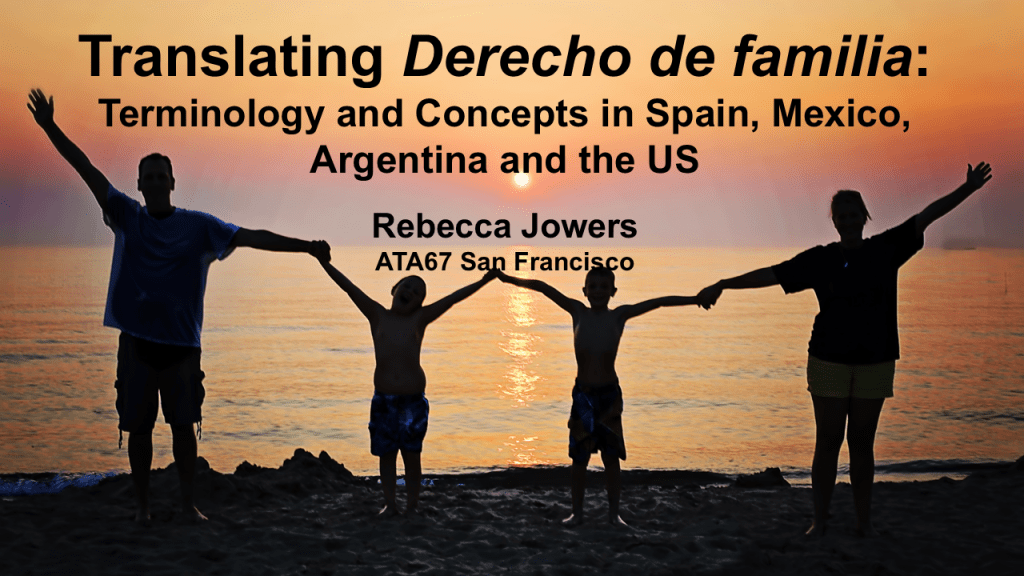
In case it may be of interest to some of the attendees, I will be giving a 3-hour AST session at the American Translators Association’s Annual Conference in San Francisco in October. Here is an outline of what we’ll be discussing. (After the session, attendees will receive an 800-term Glossary of Spanish-English Family Law Terms extracted from my Diccionario de términos y conceptos jurídicos español-inglés that includes all terms and concepts covered.)
An extensive overview of the terminology and concepts of Derecho de Familia, comparing and contrasting family law in the ancient (1889) but much amended Spanish Código Civil, the Mexican Código Civil Federal (1928), and the modern Argentine Código Civil y Comercial de la Nación (2015).
- Focus on translation pitfalls: Survey of the most common problems translators and interpreters may encounter when working in family law contexts
- For each area of Derecho de familia the presenter will first introduce the basic terms and concepts, suggesting possible English renderings for each, followed by a summary of the differences that might be found in Spanish, Mexican and Argentine texts.
Summary of Session Content:
- Derecho de familia (family law; domestic relations)
- Content of family law (what we’re talking about)
- Sources of family law (where all of this comes from)
- Familia y parentesco (Family and Kinship)
- Differing and evolving definitions of familia prompting changes in ES-EN concepts and terminology
- Matrimonio (Marriage)
- Capacidad y prohibiciones matrimoniales (capacity and prohibitions to marry)
- Formas y efectos del matrimonio (forms and effects of marriage)
- Uniones de hecho (Nonmarital Relationships)
- Regímenes económico-matrimoniales (Marital Property Systems)
- Sociedad de gananciales (ES); sociedad conyugal (MX); comunidad de ganancias (AR): parallels with marriage in US community property states
- Bienes privativos vs. bienes gananciales (separate vs. community property)
- Nulidad, separación, divorcio (Annulment, Separation, Divorce)
- Crisis matrimoniales (break-down of marriage)
- Disolución de matrimonio (is not “dissolution of marriage”)
- Separación de hecho vs. separación judicial (de facto separation vs. judicially-decreed separation)
- Divorcio incausado (no-fault divorce)
- Divorcio contencioso/no contencioso (contested/uncontested divorce)
- Convenio regulador (marriage settlement agreement)
- Pensión compensatoria (spousal support)
- Alimentos (child support)
- Custodia (custody arrangements for minor children)
- Filiación; relaciones paternofiliales (Parent-child Relations)
- Hijos matrimoniales y no matrimoniales (marital and nonmarital children)
- Acciones de reclamación de paternidad (paternity suits)
- Reconocimiento de paternidad (acknowledgment of paternity)
- Patria potestad/Responsabilidad parental (Parental Responsibility)
- The shifting focus of patria potestad: from legal custody to parental responsibility
- Acogimiento (Foster Care)
- Administraciones de Protección de Menores; Servicios Sociales (Child Protection Services)
- Acogimiento familiar vs. acogimiento residencial (family foster care vs. residential foster care)
- Adopción (Adoption)
- Expediente de adopción y estudio psicosocial de los adoptantes (adoption proceedings and suitability assessment of adoptive parents)
- Obligaciones de alimentos entre parientes (Family Support Obligations)
- Instituciones tutelares (Protective Care Arrangements)
- Tutela y curatela (guardianship); defensor judicial (guardian ad litem); guarda de hecho (de facto guardian), otros
- Differing definitions of tutela, curatela, guardianship of the person, guardianship of the estate, and conservatorship.