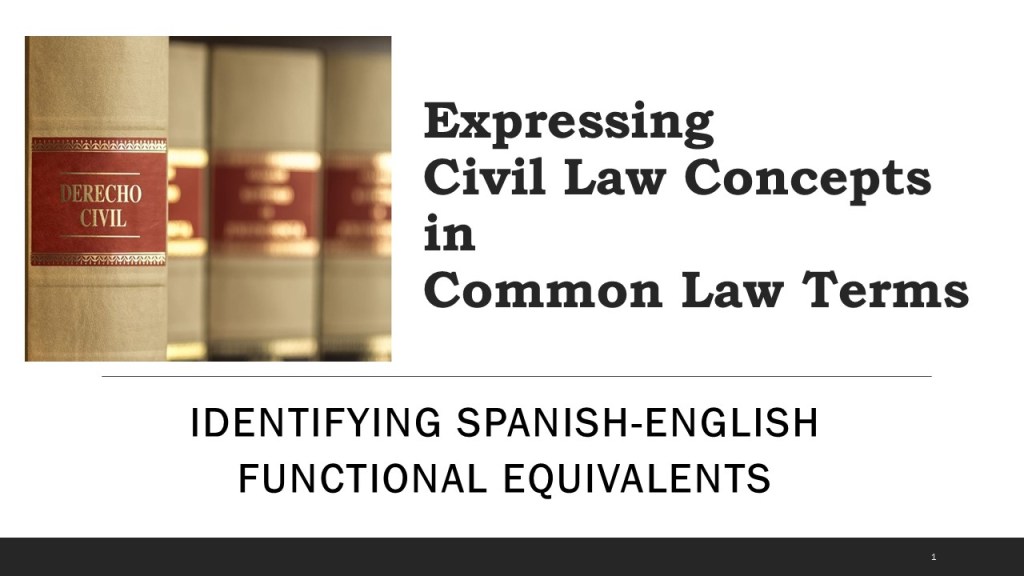
On Tuesday, May 27th (6pm Madrid time) I will be giving a webinar on the Academia de los Grandes Traductores platform.
In our discussion of how to identify functional equivalents, we’ll look at the following aspects with Spanish and English examples for each:
- Civil law vs. common law: we are dealing with two very different legal systems
- Are there really any true “equivalents”? Is legal translation even possible?
- When expressing civil law concepts in common law terms, can we use the terminology of English-speaking civil law jurisdictions? What about Louisiana? (a look at some Louisiana civil law “equivalents”)
- Is the terminology of comparative law scholars useful?
- Won’t this all depend on the target audience?
- How can we identify functional equivalents? (Determining which ones will work and which ones won’t)
- Functional equivalents that “work,” that “fit.” (Examples from Spanish Derecho civil, Derecho mercantil, Derecho de los contratos and Derecho procesal)
- Generally-accepted functional equivalents revisited (ones that may not be the best choice after all)
- Functional equivalents that may simply not be close enough
- Functional equivalents that are only “half-right,” that don’t convey the whole concept or that leave out an important aspect of the original civil law term or expression
- Functional equivalents that may work in one jurisdiction but prompt a miscue in the other
- Functional equivalents that may work in England and Wales, but not in the US
- Functional equivalents that may work in the US, but not in the UK
- Common all-too-literal translations that may have a reasonable functional equivalent after all
- Functional equivalents that don’t work and that are likely to prompt a miscue
- Functional equivalents hiding in plain sight (they may be there if we look hard enough)
If you would like to sign up, click here.
 Léxico Jurídico Español-Inglés