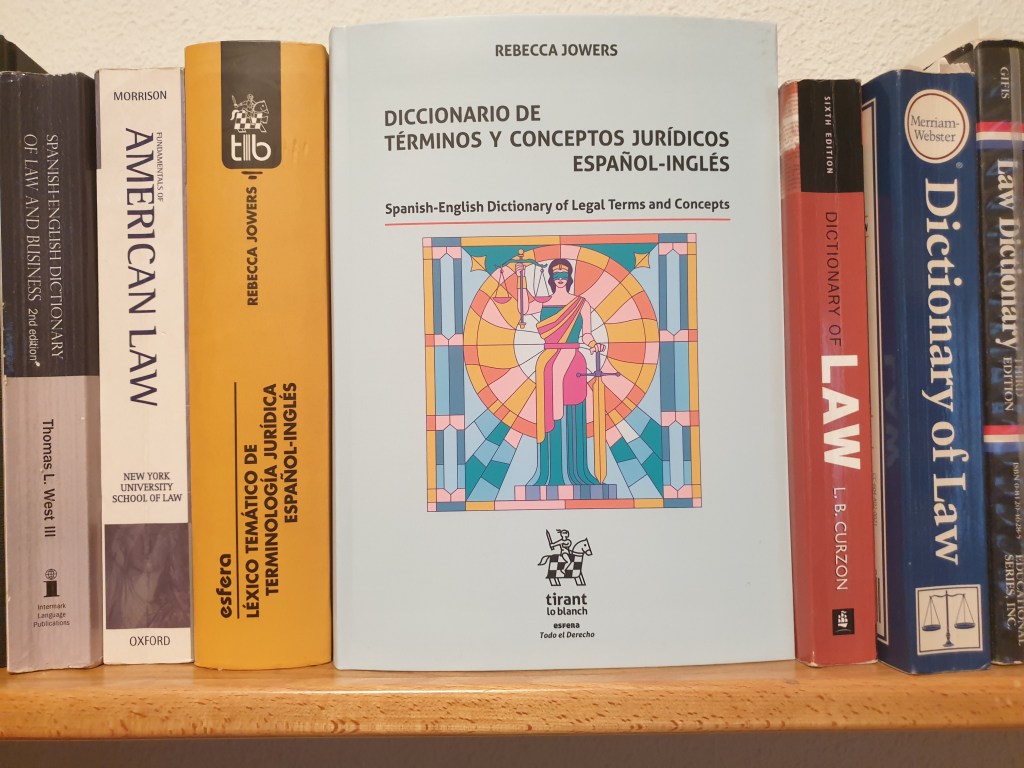
At a certain age, you start contemplating retirement. (Those of you who know me know that I’m well over retirement age, but I’m not quite there yet.) But looking toward the not-so-immediate future, it occurred to me that the Spanish-English legal terminology glossaries that I’ve compiled over my 40-year career as a legal translator and professor of Legal English might prove useful to others in this field. (These include ES-EN legal translators and interpreters, as well as other legal professionals, such as my translation clients who are either lawyers who have to explain Spanish law in English to their English-speaking clients, or Spanish law professors who lecture and publish in English.)
Thanks to the fine work of the Tirant lo Blanch Legal Publishers, my glossaries were just published here as Diccionario de términos y conceptos jurídicos español-inglés in both print and ebook.
This is a companion work to my 2015 Thematic Lexicon of Spanish-English Legal Terminology that presented in detail the terms and concepts of 15 areas of Spanish law.
But this Dictionary includes terminology from 45 additional fields of law including arbitration, accounting, administrative law, advertising law, auditing, budgetary law, civil law, civil procedure, commercial transactions, competition law, constitutional law, consumer law, contract law, copyright law, corrections law, corporate law and the law of business organizations, criminal law, criminal procedure, customs, economics, electoral law, environmental law, EU law, family law, finance, forensic science, human rights, immigration law, Incoterms, inheritance law, law of succession, insurance law, insolvency law, international law, intellectual and industrial property, law and the judicial system, labor law, labor procedure, legal education, legal practice, maritime law, negotiable instruments, law of public notaries, law of obligations, patent law, law of persons, procedure (general), property law, law of public registers, securities law, social security law, tax law, trademark law, tort law, transportation law, unfair competition, urban planning, water rights and other general terminology.
For more information, see here

 Léxico Jurídico Español-Inglés