Legal English for Spanish Speakers: Multiple Meanings of “board”

When “board” denotes a group of persons exercising managerial or supervisory powers, it can have several different Spanish renderings. In business law contexts in Spain, a company’s “board of directors” is its consejo de administración (called junta directiva or directorio in other Spanish-speaking jurisdictions). In other respects, the “board of trustees” of a foundation (fundación) is its patronato.

“Board” is also used in the context of alternative dispute resolution (resolución extrajudicial de conflictos), in which arbitration (arbitraje) may be conducted by a single arbitrator (árbitro único) or by a panel of arbitrators commonly known as an “arbitration board” (tribunal arbitral).

In the US, a state or local entity that governs and manages the public school system is commonly know as the “board of education.” And “board” may likewise designate a type of governmental body or entity. In that regard, what in Spain are collectively termed organismos administrativos (generically, “governmental agencies”) receive several different names within the US government. One of these is “board” (Federal Reserve Board–FRB; National Labor Relations Board–NLRB, etc.), but also include “agencies” (Central Intelligence Agency–CIA; Environmental Protection Agency–EPA), “bureaus” (Federal Bureau of Investigation–FBI) and “commissions” (Securities and Exchange Commission–SEC; International Trade Commission–ITC).

False Friends: “asesinato” vs. assassination

These are true false friends, “assassination” (the deliberate killing of a public figure) being magnicidio, while asesinato is generally associated with “murder” (the intentional premeditated unlawful killing of a human being). With respect to the latter, the specific related offenses defined in the Spanish Criminal Code (Código Penal) include homicidio imprudente, homicidio (doloso) and asesinato. How these terms are translated may depend on the target audience, but generally homicidio (doloso), defined as matar dolosamente a otra persona, may perhaps be best rendered simply as “murder.”

In contrast, as defined in Spain asesinato requires killing con alevosía (measures that an offender takes to ensure their impunity), por precio, recompensa o promesa (for hire, reward or promise of reward), or con ensañamiento (with extreme cruelty). Committing murder con alevosía implies depriving the victim of any means of defense (inexistencia de posibilidades de defensa por parte del sujeto pasivo), while ensañamiento is defined as aumentar deliberada e inhumanamente el sufrimiento de la víctima en la ejecución del delito. In view of these requisites, if homicidio (doloso) is rendered as “murder,” asesinato may perhaps be appropriately described as “aggravated murder” or “first-degree murder.” In other respects, homicidio imprudente may possibly be rendered as “manslaughter” (unlawful killing without express or implied intent to do injury), but when a distinction must be made between homicidio imprudente grave and homicidio imprudente leve expressions such as “reckless homicide” and “negligent homicide” may perhaps prove useful.

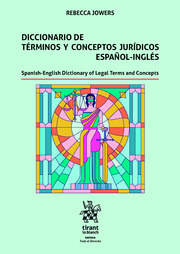
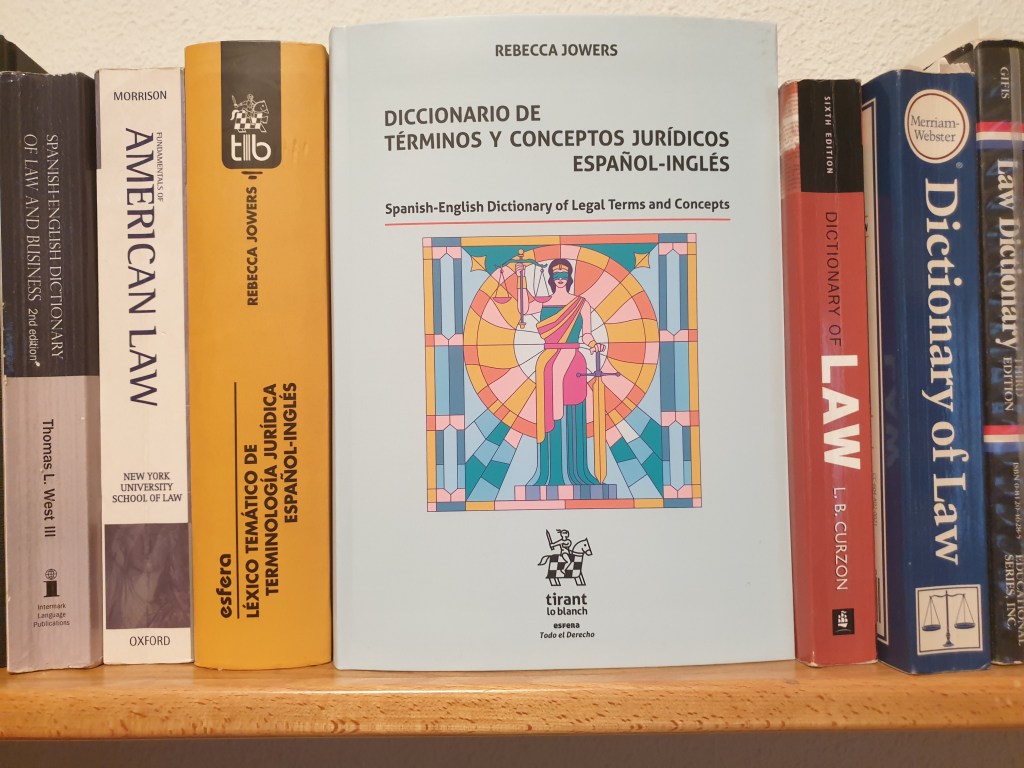
New! Just published! Spanish-English Dictionary of Legal Terms and Concepts

At a certain age, you start contemplating retirement. (Those of you who know me know that I’m well over retirement age, but I’m not quite there yet.) But looking toward the not-so-immediate future, it occurred to me that the Spanish-English legal terminology glossaries that I’ve compiled over my 40-year career as a legal translator and professor of Legal English might prove useful to others in this field. (These include ES-EN legal translators and interpreters, as well as other legal professionals, such as my translation clients who are either lawyers who have to explain Spanish law in English to their English-speaking clients, or Spanish law professors who lecture and publish in English.)

Thanks to the fine work of the Tirant lo Blanch Legal Publishers, my glossaries were just published here as Diccionario de términos y conceptos jurídicos español-inglés in both print and ebook.

This is a companion work to my 2015 Thematic Lexicon of Spanish-English Legal Terminology that presented in detail the terms and concepts of 15 areas of Spanish law.

But this Dictionary includes terminology from 45 additional fields of law including arbitration, accounting, administrative law, advertising law, auditing, budgetary law, civil law, civil procedure, commercial transactions, competition law, constitutional law, consumer law, contract law, copyright law, corrections law, corporate law and the law of business organizations, criminal law, criminal procedure, customs, economics, electoral law, environmental law, EU law, family law, finance, forensic science, human rights, immigration law, Incoterms, inheritance law, law of succession, insurance law, insolvency law, international law, intellectual and industrial property, law and the judicial system, labor law, labor procedure, legal education, legal practice, maritime law, negotiable instruments, law of public notaries, law of obligations, patent law, law of persons, procedure (general), property law, law of public registers, securities law, social security law, tax law, trademark law, tort law, transportation law, unfair competition, urban planning, water rights and other general terminology.

For more information, see here

False Friends in Legal Spanish: “impertinente” is not impertinent

In legal usage “impertinent” and impertinente can usually be considered false friends. In nonlegal Spanish, impertinente has two possible meanings (taken from the DLE): 1) “que no viene al caso” (in English, “irrelevant”) and 2) “que molesta de palabra o de obra” (in English, “impertinent”).

In Legal Spanish impertinente generally has the first meaning: que no viene al caso; que es irrelevante (and, therefore, the matter in question is improcedente; no procede en Derecho). In the Spanish Law of Evidence there are two clear examples: prueba impertinente and pregunta impertinente. Prueba impertinente is defined as “prueba que no guarda relación con el objeto del proceso” (in Legal English, “irrelevant evidence”). This prohibition of irrelevant evidence is set forth in article 283.1 of the Ley de Enjuiciamiento Civil that provides that “no deberá admitirse ninguna prueba que, por no guardar relación con lo que sea objeto del proceso, haya de considerarse impertinente.

In that regard, evidence can be classified as prueba pertinente or prueba impertinente (“relevant or irrelevant evidence”), prueba útil or prueba inútil (“material or immaterial evidence,” in the sense of being appropriate or inappropriate for demonstrating the fact that it is intended to prove), and prueba directa or prueba presencial (“direct evidence” or “eyewitness evidence”) as opposed to prueba indirecta or prueba indiciaria (“indirect evidence” or “circumstancial evidence”).

The same applies to preguntas impertinentes (in Legal English, “irrelevant questions”) that may not be used when examining witnesses at trial. The DPEJ defines pregunta impertinente as “cuestión que no deba ser respondida en juicio por el interrogado, al no corresponder con los hechos litigiosos o no guardar relación con el declarante.” And in addition to preguntas impertinentes (irrelevant questions), Spanish Law of Evidence likewise prohibits the use of preguntas sugestivas (“leading questions”) and preguntas capciosas (“misleading or trick questions”).

Look-alikes in Spanish Tax Terminology: pagos a cuenta vs. pagos fraccionados

These look-alike Spanish tax law expressions have sometimes been confused in translation but are not synonymous. Pagos a cuenta denotes “advance tax payments” made quarterly during the tax year, for example, by the self-employed (trabajadores autónomos; trabajadores por cuenta propia). In US tax terminology these are known as “estimated tax payments.”

In contrast, pagos fraccionados refers to tax payments made in installments. Spanish tax law (Ley General Tributaria) provides for splitting tax debts into installments known as fraccionamiento del pago. In the case of Spanish individual income tax (impuesto sobre la renta de personas físicas—IRPF), June 30 is the deadline for filing tax returns (presentación de la declaración de la renta). Any taxes owed may be paid in two installments, with 60% due when filing, and the remainder to be paid in November.

Confusing terms: propiedad intelectual; propiedad industrial; intellectual property

In Spain and other Spanish-speaking jurisdictions a distinction is made between propiedad intelectual, which principally refers to “copyright” (derechos de autor) and propiedad industrial, which includes trademarks (marcas), tradenames (nombres comerciales), patents (patentes), utility models (modelos de utilidad), industrial models and designs (modelos y diseños industriales), and the protection of domain names, semiconductor chip masks and plant varieties (protección de nombres de dominio, topografías de productos semiconductores y obtenciones vegetales), etc.

This division is underscored by the fact that in Spain propiedad intelectual and propiedad industrial are protected under totally separate laws: on the one hand, the “Consolidated Text of the Copyright Act” (Texto Refundido de la Ley de Propiedad Intelectual); and on the other, the “Trademark Act” (Ley de Marcas), “Patent Act” (Ley de Patentes), and additional legislation protecting other modes of industrial property.

Moreover, different entities handle the registration of Spanish intellectual and industrial property. The Central and Regional Copyright Registers (Registro General y Registros Territoriales de la Propiedad Intelectual) are maintained and supervised by the Ministerio de Cultura y Deporte, while industrial property rights are protected through registration at the Spanish Patent and Trademark Office (Oficina Española de Patentes y Marcas, OEPM), a division of the Ministerio de Industria, Comercio y Turismo. And, traditionally, propiedad intelectual is an aspect of property law covered in the Código Civil, while propiedad industrial was initially governed under the Código de Comercio and is considered a part of Derecho mercantil. Today, propiedad intelectual is still studied in Spanish law schools as a part of Civil Law. But, since these are such closely related disciplines, Manuales de Derecho mercantil now generally include both.

In contrast to the above, in English “intellectual property” is a broad term that encompases both the Spanish propiedad intelectual and propiedad industrial. And, in addition to copyright, trademarks, patents, etc., intellectual property textbooks used in US law schools often include related disciplines such as unfair competition (competencia desleal), trade secrets (secretos industriales), false advertising (publicidad engañosa) and the protection of publicity rights (derechos de imagen).